
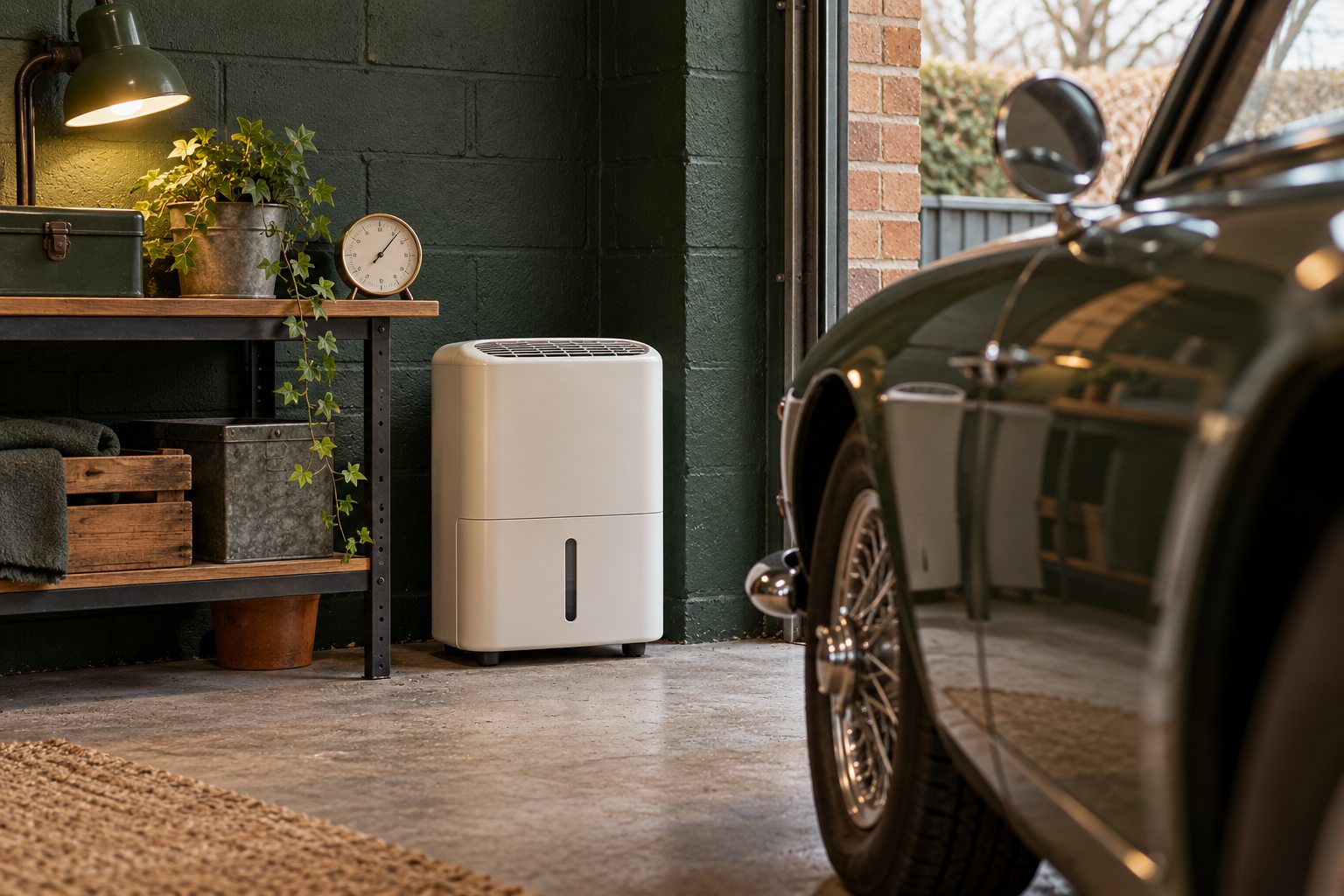
If your garage has recurring water patches, condensation on the car or damp materials, investigate before leaving the car there for a long lay-up. A hygrometer helps describe the conditions, but one reading cannot tell you that the car is protected. Start by separating water entering the building from moisture condensing inside it.
| What you notice | What to record | First investigation |
|---|---|---|
| A patch returns after rain | Position, rain timing and any visible water trail | Rain entry or drainage |
| Droplets appear on several cool surfaces | Time, weather, air temperature and humidity | Condensation |
| Damp is concentrated under a mat or box | Both sides of the item and the exposed floor | Local moisture and the floor beneath |
| The meter shows high relative humidity | Temperature, meter position and recent activity | Repeat readings and look for a pattern |
These are investigation prompts, not diagnoses. A garage can have more than one moisture problem at the same time.
Why the temperature matters
The Met Office explains relative humidity and dew point. Relative humidity describes how close air is to saturation at its current temperature. It can change as the temperature changes even when the amount of water vapour stays similar. Dew point is the temperature at which condensation begins.
For garage storage, this means a falling humidity percentage after the room warms does not, by itself, show that moisture has been removed. Equally, a room reading does not describe every cold surface around the car. Record visible droplets alongside the readings rather than letting the meter overrule what you can see.
There is no universal humidity number in this guide that guarantees freedom from corrosion. The vehicle's condition, local moisture and the limitations of your meter still matter.
Keep a record you can act on
Choose a repeatable meter position near the storage area, away from the direct outlet of an appliance. Follow the meter's instructions for placement and settling time. Label any additional spot readings so that you do not compare different locations as if they were the same.
Use a notebook or spreadsheet with these columns:
| Date and time | Air temperature | Relative humidity | Rain or weather change | Garage activity | Visible moisture |
|---|---|---|---|---|---|
| Your observation | Your reading | Your reading | What happened | Wet car, washing or door opening | Location and photograph reference |
For example, if a patch appears after rain even when the car has stayed dry, pass that pattern to the person inspecting the building. If droplets appear across cool objects during weather changes, include that observation too. Neither pattern proves the cause without inspection.
Deal with water entry before choosing equipment
Inspect accessible areas from ground level and photograph recurring patches. Do not climb onto a roof or get underneath an unsupported car to investigate damp. Arrange a competent assessment if water entry persists, building materials are damaged or drainage is uncertain.
Check the floor moisture guide before hiding a patch under a mat or coating. A dehumidifier removes moisture from air; it does not repair the route through which rain enters.
Meaco's garage guidance highlights cold-weather appliance performance and the need for air circulation around stored belongings. Its recommendations concern its own range. Use the exact model's manual and your temperature record rather than assuming every desiccant or compressor appliance behaves alike.
Read dehumidifier selection and use the garage humidity check to compare your readings with the reference models' operating ranges. The tool does not calculate building heat loss, moisture load or a corrosion risk score.
Check again after making a change
Keep the same observation routine after repairs or installing equipment. Note what changed and when, then look for returning patches, droplets and damp materials as well as the meter readings. Change one manageable thing at a time where practical so that the record remains useful.
Do not block designed ventilation or change ventilation serving combustion appliances without qualified advice. Review cover suitability separately: putting a cover over the car does not establish that the garage problem is resolved.
Sources
- Met Office: relative humidity and dew point — checked 26 October 2026.
- Meaco: garage dehumidifier guide — checked 26 October 2026. Manufacturer guidance, not independent product testing.
Sources & checks
Checked 2026-10-26. Read the original instructions before acting.