
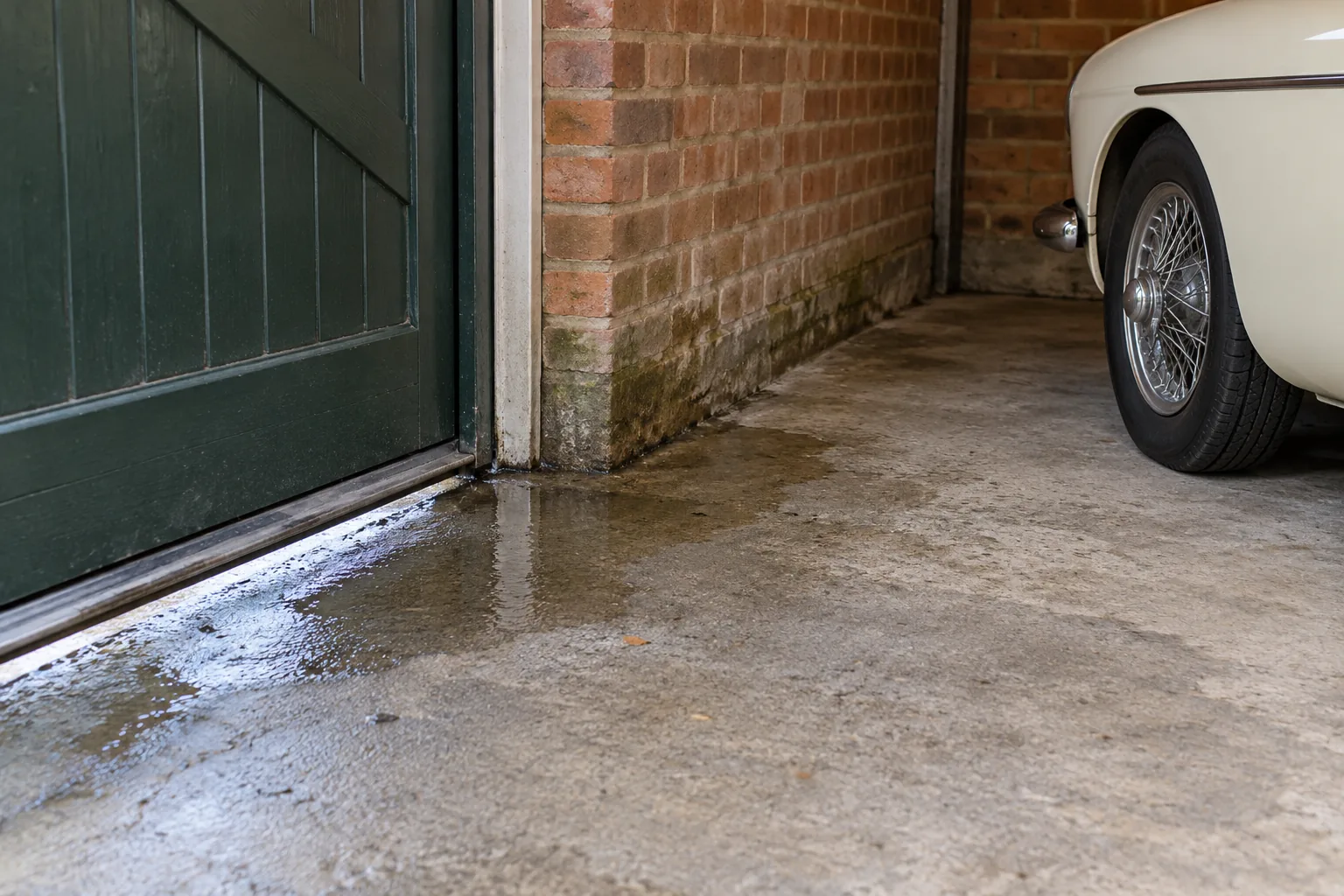
A damp garage floor needs investigation before you cover it. A mat, paint or enclosure may be part of a storage setup, but choosing one does not establish where the water came from. First record whether the patch follows rain, washing, parking a wet car or changes in the weather.
| Pattern to investigate | Record before changing anything | Question to resolve |
|---|---|---|
| Water near the entrance after rain | Edge of the patch and any visible trail | Is water entering from outside? |
| Wetness where the car was parked | Timing, vehicle position and recent use | Could this be water carried in, or an unidentified vehicle leak? |
| Damp under a mat or stored item | Underside of the item and exposed floor | Is the problem local or more widespread? |
| Recurring damp across the slab | Locations, weather and existing coatings | Does the floor need a moisture assessment? |
Do not assume an unidentified liquid is rainwater. Seek help for a suspected vehicle leak, particularly if there is a fuel smell. Observations narrow the questions; they do not diagnose the slab or certify the car.
Inspect what you can reach safely
Move lightweight loose items and check the visible floor. Photograph cracks, flaking coatings and recurring patches, and sketch their position relative to the door, walls and car. Keep a record before cleaning so that a contractor can see the original pattern.
Do not crawl beneath an unsupported car or move it solely to inspect the floor if its condition is uncertain. Get suitable help for inaccessible areas. Persistent damp, damaged slabs and drainage concerns need assessment of the building rather than a shopping list of floor products.
If the floor is only one part of a wider problem, use the damp garage worksheet to record air temperature, humidity and condensation elsewhere.
Room humidity and floor moisture are different checks
A room hygrometer measures the surrounding air. It does not establish the moisture condition within a concrete floor or whether a particular coating can be applied.
Bostik's substrate guidance calls for dampness testing before smoothing a floor and distinguishes preparation for different substrates. Its wider guidance also asks whether a floor is subject to seepage or rising damp. That is a reason to request an assessment, not to select a barrier or levelling system from a photograph.
Ask the flooring specialist which test the proposed system requires, where it will be carried out and how the result will be recorded. A bare percentage without the test method and the manufacturer's acceptance limit is not enough to check suitability.
Before agreeing to a coating
Send the installer photographs, the moisture record and details of any known existing finish. Ask for the proposed system in writing, including:
- The moisture test and acceptance limit required by its manufacturer.
- Whether the substrate and existing paint are suitable, and how contamination or loose material will be dealt with.
- The required temperature, drying conditions and ventilation during application and curing.
- When the floor can take vehicle traffic, rather than just foot traffic.
- Cleaning, spill handling and inspection instructions after installation.
For example, Ronseal's garage floor paint instructions separate walking and recoating from the later return of a car. They also state exclusions for certain floor types. Those instructions belong to that product; do not transfer them to a different coating or assume every garage floor is suitable.
Follow the chosen product's current label and safety information. This guide does not specify a coating, structural repair or damp-proofing system.
If you are considering a mat
Before buying, ask how you will lift, clean and dry it, and how you will continue inspecting the floor beneath. Check the maker's instructions for the proposed floor finish, vehicle use and any liquids it may encounter. Plan access around the car so routine checks do not require awkward lifting or unsafe movement.
A mat that conceals a returning patch makes the investigation harder. If damp reappears beneath it, record both surfaces and revisit the cause before replacing it with another covering.
Recheck the storage arrangement
After repairs or installation, repeat the observations through the conditions that previously produced the patch. Keep the before-and-after record with the contractor's instructions. A dry-looking surface on one visit is not evidence that an intermittent problem has gone away.
Compare room dehumidification and car storage enclosures as separate storage decisions. Neither should be treated as evidence that a building defect has been repaired.
Sources
- Bostik UK: preparing the substrate — checked 26 October 2026.
- Ronseal: Diamond Hard Garage Floor Paint instructions — checked 26 October 2026. Used as an example of product-specific application requirements, not a product recommendation.
Sources & checks
Checked 2026-10-26. Read the original instructions before acting.